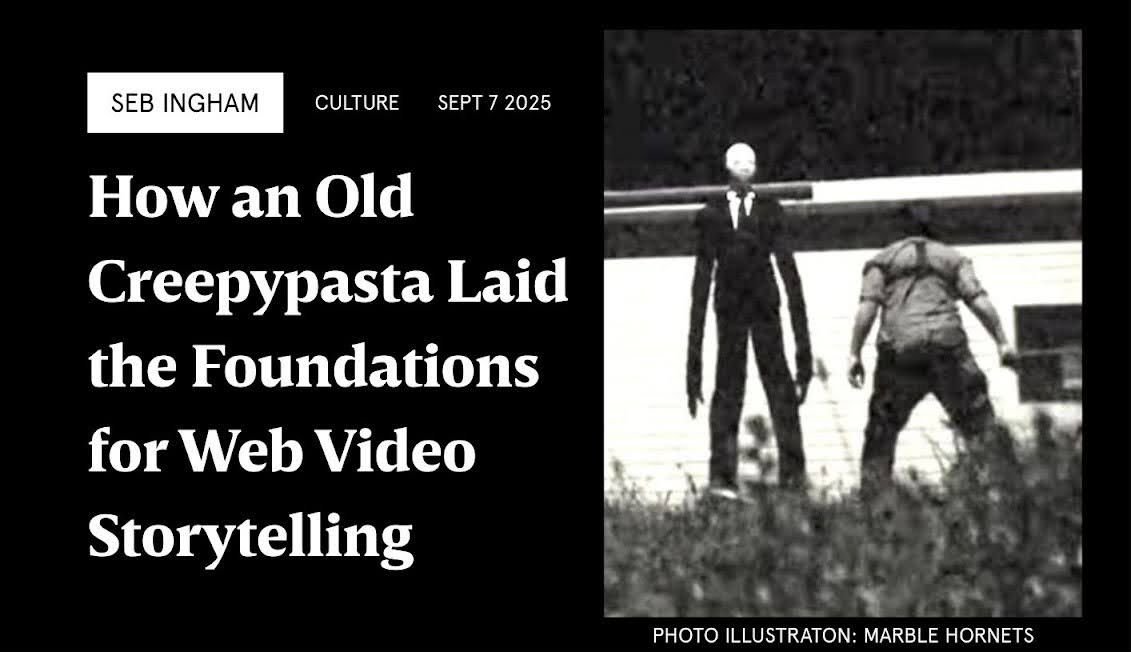
The revival of a legendary internet horror phenomenon – and how it pioneered a new format for digital narratives.
As of the 7th of September 2025, a spinoff of an old YouTube series called Marble Hornets has begun its release – eleven years after the series’ last official upload. Entitled Rosswood, this spinoff aims to explore an alternate timeline in which the characters of the original Marble Hornets series discover the existence of a supernatural monster in the present day, rather than in 2009 when the original series debuted.
In the 2000s and early 2010s, digitisation was redefining the ways audiences were viewing media. With the widespread adoption of the smartphone, and the rapid increases in the power, portability and affordability of computers and laptops, the digital content landscape was primed for an explosion of experimental new ideas brought about by rapidly increasing accessibility.
Chief among these emerging content platforms was the creation of YouTube in 2005, giving rise to the amateur web video content genre as we know it today. YouTube, as well as other prevalent sites of the time like MySpace, provided the opportunity for anyone to publish their creative work without any sort of barrier to entry or upfront financial cost – provided the uploader had the means to create their content in the first place.
This unrivalled accessibility lent itself well to more experimental forms of storytelling, a trait that Troy Wager and Joseph DeLage, a couple of film students from Alabama, would make use of with the launch of the Marble Hornets web series in June of 2009. This series, based on a short horror-themed art post on the Something Awful forums, would go on to play a central role in the popularisation of the Slender Man mythos.
Even modern internet users will have likely heard, at least in passing, of the Slender Man: a tall, suited figure with no face who drives its victims to insanity by sporadically appearing in the shadows, distorting electronic recording equipment, and eventually corrupting its victim’s minds and turning them into its psychotic puppets (often referred to as ‘proxies’). Throughout the late 2000s and early 2010s, the character would become a well known ‘creepypasta’ - a horror story that spreads across the internet via word of mouth, often being presented as an urban legend based in reality.
Several of the Slender Man’s most iconic design characteristics can be traced back to its depiction in Marble Hornets – referred to as The Operator in the series. These include the aforementioned electronic distortion and mind-control aspects of the creature, as well as its influence causing physical sickness in its victims, and their compulsions to scrawl the ‘Operator symbol’ among other insane depictions of the creature onto their surroundings. This trait directly inspired the viral 2012 indie game ‘Slender: The Eight Pages’ – another critical factor in the character's popularisation.
Outside of its innovative portrayal of The Operator – both in terms of narrative and visual implementation (at least, following the early days of DeLage creeping around in a white balaclava) – Marble Hornets is known for its effective use of the web video format to amplify its realism and narrative intrigue.
The first episode of Marble Hornets, ‘Introduction,’ was uploaded on the 20th of June, 2009, with the final part, ‘Entry #87,’ being published exactly five years later on the 20th June, 2014. During this five year period, there were three distinctive blocks of activity, punctuated by spells of inactivity which essentially break the series into three seasons. The found footage nature of the web series makes these breaks in the narrative far more immersive than if the series was to arbitrarily split itself into traditional episodes and seasons (a very plausible concern given the passion project nature and abnormal length of the series).
Web video’s lack of paratextual framing was highly beneficial to Marble Hornets – at no point was there any reference to the idea of the series being fictitious, as opposed to traditional TV shows which are constructed within the understanding that the audience is watching a curated performance, complete with title card, attributions, credits etc. The accompanying Marble Hornets Twitter account added to this realism with the protagonist, Jay (portrayed by Wagner), posting frequent updates on his progress, mood, and movements throughout the series, with the account eventually being taken over by another character in a realistic manner following Jay’s incapacitation later in the series.
This realistic framing carries into the ways the characters interact within the series as well. Characters acknowledge the existence of the YouTube series, most commonly by Jay in relation to the possibility of other characters discovering his investigation into The Operator, and potentially being able to track his location based on the contents of his uploads. Other characters also create their own uploads on separate channels in response to Jay’s efforts; the mysterious account ‘totheark’ posting cryptic distorted messages to Jay, often containing hidden codes that grant hints about the overarching narrative when cracked.
Marble Hornets takes this narrative concept a step further with the character of Tim, an old friend of Jay’s from film school who had been mentally tormented by The Operator for years, eventually discovering Jay’s true intentions behind re-establishing contact with him. This leads to a physical altercation in ‘Entry #59’ with Tim attacking Jay, screaming that he had seen everything on YouTube and knew exactly why Jay was so interested in meeting him, and the amount of danger he was putting them both in, before storming off.
By blurring the lines between character and audience in this way, Marble Hornets is able to achieve a level of narrative immersion that would not be possible using conventional storytelling formats. This lack of narrative barrier between character and audience also encourages viewers to look more closely into the cryptic narrative, as they themselves will have to investigate alongside Jay to discover the true extent of the mystery. This must be done by locating and cracking the aforementioned codes hidden within totheark uploads, as well as by piecing together the clues Jay discovers independently as he is often too caught up in the horrors and dangers of the investigation to formulate or summarise his findings.
In terms of the wider web video series genre, Marble Hornets was one of the defining early examples of the format's use in highly immersive storytelling. The series would go on to inspire several similar series based around the Slenderman mythos, such as EverymanHYBRID and Tribe Twelve between 2010 and 2019, which would also find success within the community – albeit not to the level of their original inspiration.
The series received a film adaptation in 2015, Always Watching: A Marble Hornets Story, produced in part by the original writers of the web series. This film, as well as the subsequent Slender Man in 2018 (a film based more around the Slender Man mythos than on Marble Hornets specifically) failed to live up to expectations, both garnering generally negative audience reviews. The reception of these films suggest that the framing associated with web video is one of Marble Hornets strongest attributes; while the narrative broadly falls flat on the big screen, the original YouTube series is still held in high regard by fans to this day – even if some elements are not as groundbreaking as they were in the early 2010s.
Ultimately, Marble Hornets proves that enigmatic, ‘found-footage’ style content fits incredibly well with the web video format. The recent reimagining of the original Marble Hornets story in Rosswood reflects this, suggesting that this form of storytelling remains effective despite the ingenuity of the series’ narrative framing no longer being as revolutionary.
Without the accessibility of the web video genre, it may well have been impossible for the Slender Man to reach feature film status – and, by falling flat, demonstrate just how uniquely engrossing the web video format is, especially for more cryptic styles of content.