July 31st 2026 at 15:22
Warhammer 40,000 Videogames: How Maintaining a Universe's Continuity Can Clash with Player Experience
By Sebastian Ingham
The releases of two major videogames set in the Warhammer 40K universe over the past few years, namely Warhammer 40,000: Darktide and Warhammer 40,000: Space Marine 2, has got me thinking about a subject that had been bubbling away in the fandom for decades, but had the capacity to become an ever-growing problem now that 40K is routinely being bought to life in the interactive world of video gaming.
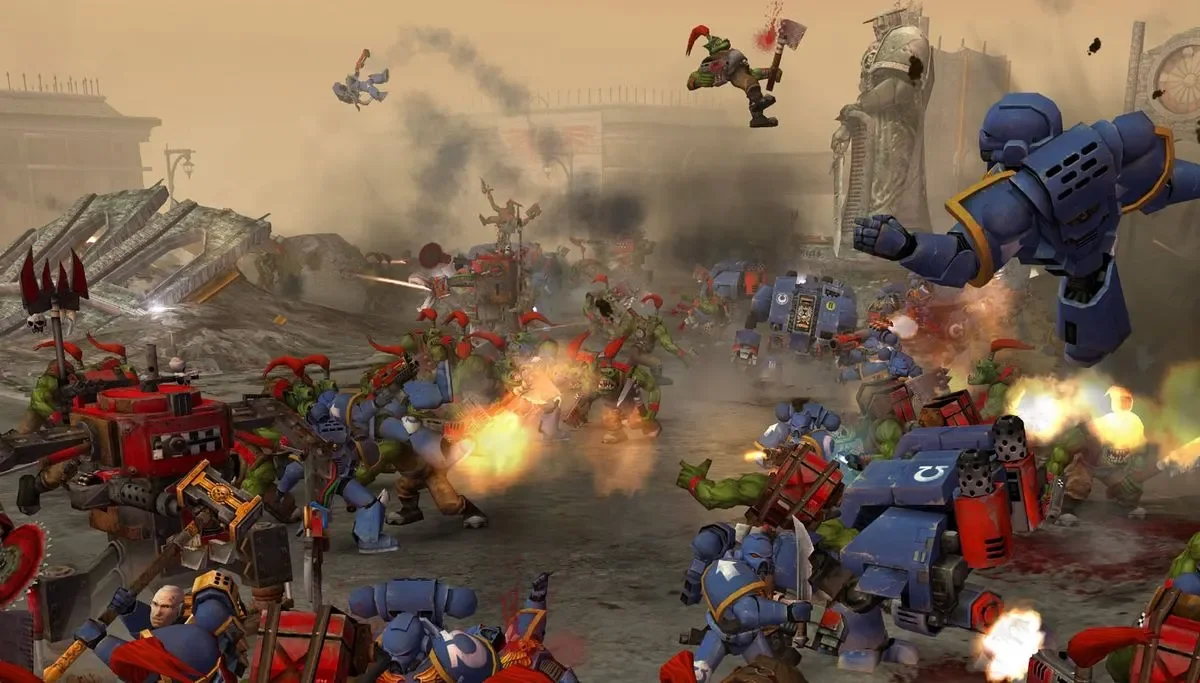
Games like the original Dawn of War from 2006 established the 40K universe as being an excellent setting for real time strategy games, however the franchise became intrinsically tied to this genre following Dawn of War’s success.
Before approaching this topic with an analytical mindset, the discourse I had seen online surrounding the debate as to how Warhammer 40,000 factions, characters and races compared in terms of power scaling and individual ability outside of the official lore felt broadly unimportant.
After all, Warhammer is a universe which encourages creativity in its fanbases wherever possible. The series’ foundation in miniature building, painting and tabletop gaming fits this world building approach to a tee, allowing for significant individual expression above and beyond the tenets of the foundational lore in player’s collections— so long as tabletop gaming viability is preserved.
While no one is stopping you from buying, painting and fielding an army of imperial titans with custom rulesets and modified statistics in the comfort of your own gaming space, attempting to do so at an official tournament, or even a local hobby shop will get you more than a few confused stares.
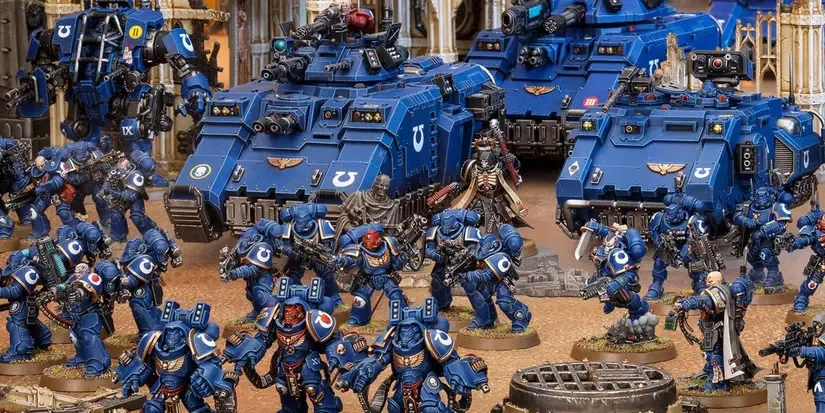
Tabletop players may choose to paint and equip their armies according to the legendary factions of the official lore, or alternatively come up with their own unique factions to create an entirely personalised collection.
With that being said, the constraints of a fixed environment and tightly honed gameplay place a natural restriction on the ability of fans to interpret the universe their own way, both in terms of the moment-to-moment action as well as in the universe’s overarching narratives.
The principle that ‘everything is canon, but not everything is true’ has long been held at the heart of the Warhammer fandom with regards to how the universe operates. Warhammer has always been a somewhat unique IP in terms of its canonical fluidity; since the majority of written content is relayed through the deeply biased and oppressive Imperium of Man rather than an omniscient narrator, and the aforementioned informational dark age that the universe is set within, the ability for individuals to piece together their own unique realities has always been a core part of Warhammer’s storytelling.
In my 15 years of experience in the fandom, I would say that this is the single most impactful narrative traits of the 40K universe. The amount of in-universe information that has simply been lost to time over the course of the Imperium of Man’s endless strife, and the power this narrative framework gives to one’s own imagination in trying to visualise such a dark, mysterious and expansive universe brimming with secrets to uncover and threats to withstand.
It was this concept (along with some truly phenomenal artwork by John Blanche, Paul Dainton and Alex Boyd among others) that drew me in at a young age, putting pieces of the universe together to create an awe-inspiring mental picture of the horrors and heroics of the 41st Millennium.
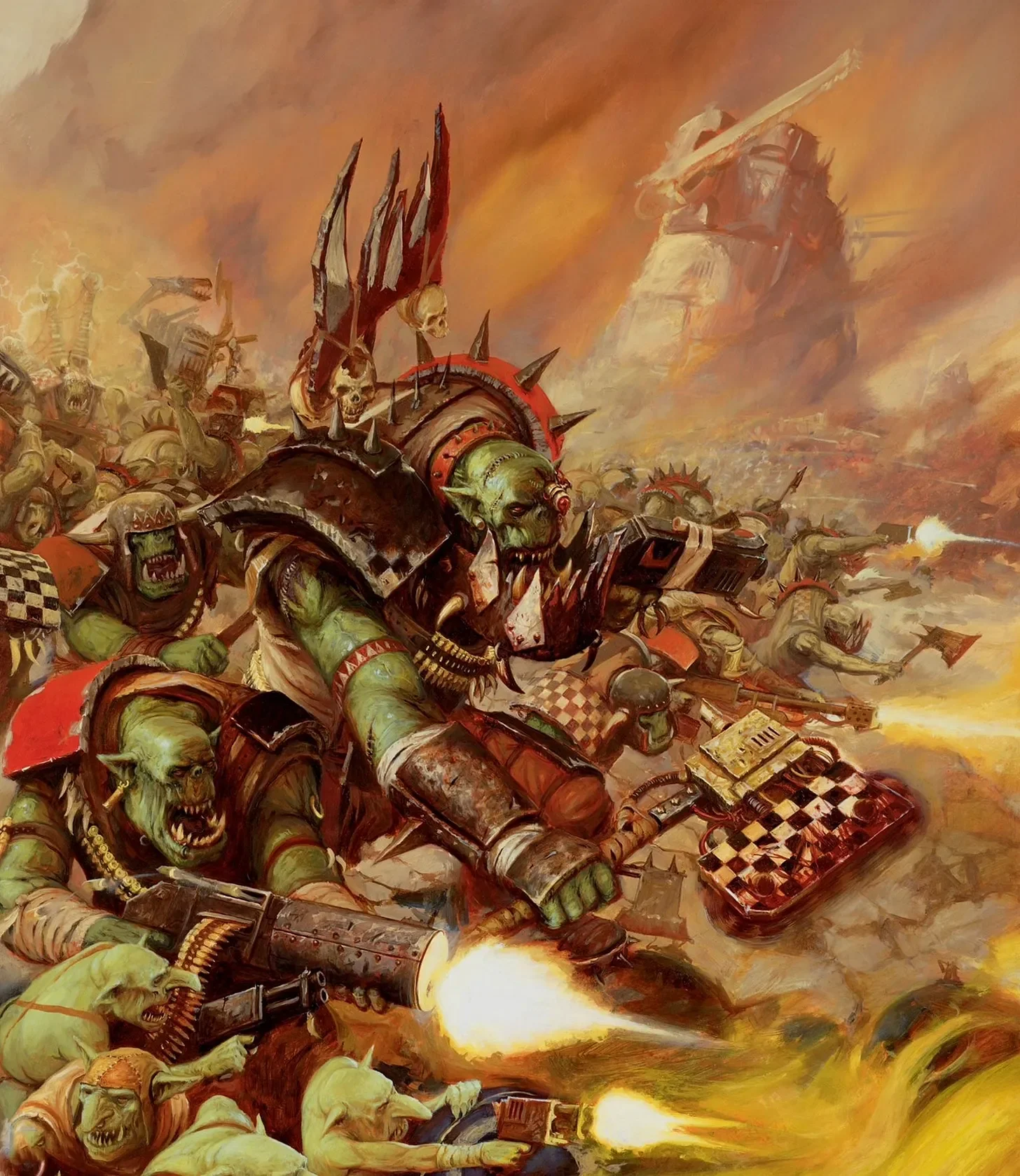
The scale and detail of Boyd’s work was instrumental in my early understanding and appreciation for the vastness of the Warhammer 40,000 universe.
Now imagine that, like me, you have grown up around this franchise, dreaming up your own personal factions and stories within the universe, perhaps designing and modelling your very own miniature army. Then imagine that this perfect image of a universe you had a strong hand in formulating is seemingly bent and constrained to fit the dimensions of a modern video game.
While many fans would be elated to be able to finally experience this universe within an interactive medium, it is perhaps easy to understand why a measurable proportion of the fanbase find issue with bringing something so intrinsically personal to themselves to life through such a potentially transformative lens.
Unlike the tabletop experience, and the wider written content sphere that surrounds it, video games leave a lot less of the universes details to the imagination, essentially presenting a fixed image that cannot be easily manipulated or explained away as in other highly individual-reliant forms of the hobby.
Nowhere has this divide been more clear than with the releases of Darktide and Space Marine 2 in 2022 and 2024 respectively.
Online discourse surrounding the physical abilities of the Darktide cast has been swirling since the games’ launch. The idea that four lowly penal conscripts could regularly overcome thousands upon thousands of poxwalkers, corrupted guardsmen and powerful single entities like Daemonhosts and Chaos Spawn may seem utterly absurd to a purely tabletop-oriented fanbase. Such feats, it has been argued, would fall within the remit of a legendary space marine command squadron rather than a group of rag-tag mercenaries, bandits, zealots and rejects.
Further discussions have been levelled at more specific aspects of the games’ universe, such as in the design and usage of various weapons, the toughness mechanic that allows players to withstand incredible amounts of damage, and the meagre 4-person-strong strike teams being deployed despite the seemingly vast number of penal soldiers available to the Inquisition.
Of course, these compromises are understandable from a gameplay perspective; the foundational structure of a horde-extraction game rely on satisfying combat and balanced team cohesion, so applying a one-to-one approach from the source material is simply unrealistic.
Similarly, Space Marine 2 has fallen under criticism from a sector of the Warhammer community, although not quite to the level that Darktide received. Complaints generally take issue with the gameplay rather than the presentation of Space Marine 2, claiming that the bolt weapons the characters wield are vastly underpowered compared to their source material counterparts, and that once again, it would not be feasible for a mere three space marines to defeat hundreds of Thousand Sons traitor squadrons, complete with Terminator detachments and Hellbrute support.
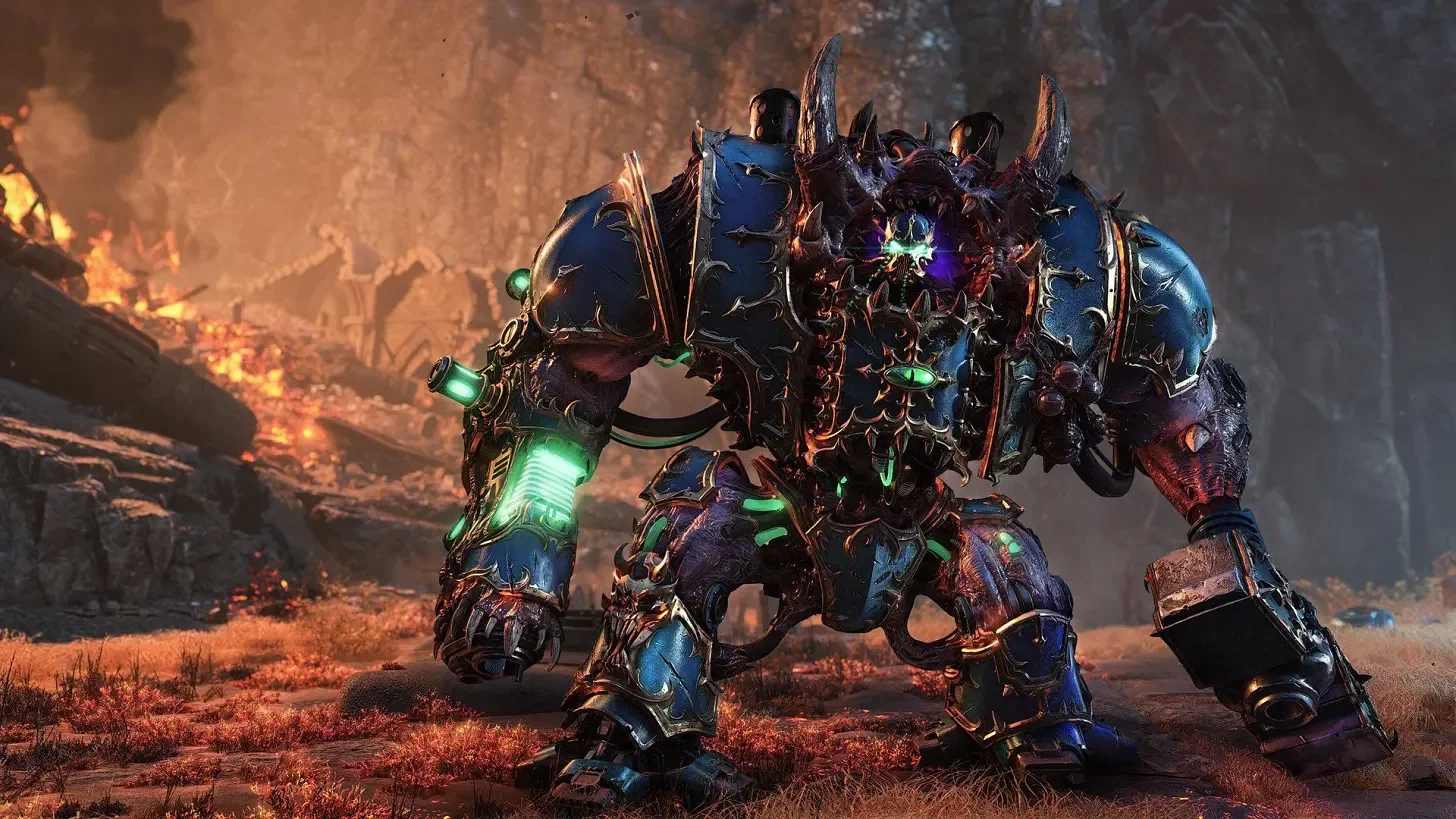
One of the two Hellbrute dreadnoughts the player squad must defeat during the main campaign of Space Marine 2. Screenshot courtesy of user XuruAnoa on reddit.
As previously mentioned, I believe it is not that these complaints are all rooted in criticism of these game’s designs per-se, rather that it can be difficult for a fanbase to let go of their preconceived ideas about a universe that they care for so deeply. This effect is only emphasised by Warhammer’s foundation in imagination and personal world building, making any kind of media that breaks these personal distinctions appear immersion breaking and unfaithful to the source material — even if that source material was never meant to be taken entirely at face value in the first place.
However, in recent times I have begun to notice an increasing trend in discussions that aim to connect the apparent lore inaccuracies seen within these games with the original written media. Posts such as those made by user Zalm_Boltado on reddit a couple of months back go into great detail in exploring how aspects of these games that have received criticism in the past can actually be explained within a more strictly lore-accurate context.
I believe that, with time, these games will assimilate into the wider Warhammer media verse just as comfortably as spinoff tabletop games, Black Library novels, and acceptance of ‘fanon’ theories have in the past. While they may well take a longer period of time to achieve the levels of ubiquitous fandom acceptance than more easily digestible forms of content, videogames as a medium have already demonstrated their unique abilities in narrative interaction and individual player immersion, and I for one hope that more new and exciting titles are established in the coming years within the grim darkness of the far-future…